
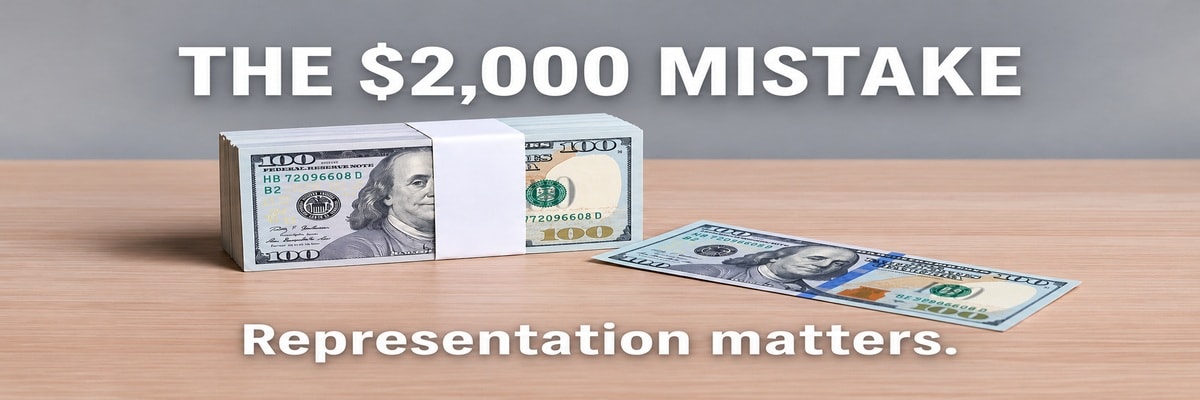
The $2,000 the Buyer Never Knew He Lost
Published September 15, 2025
Buying or selling a home isn't just a transaction — it's one of the biggest financial and emotional decisions most people ever make. Yet too often, people assume all real estate professionals are the same. Or worse, that they can handle it alone.
And let's be honest: almost everyone has a family member or friend with a real estate license. But that doesn't always mean they're the right person to guide you through the biggest financial move of your life.
Why It Matters Who You Hire
Not all agents are created equal. Having a license doesn't automatically mean someone knows how to navigate zoning mismatches, title issues, or condo associations.
As a broker/owner, I don't have the luxury of handing responsibility up the chain to a faceless manager. The buck stops with me. My customers know who's accountable — and that accountability changes everything.
The wrong hire, even if it's family, can mean missed red flags, weak negotiation, or deals falling apart. The right hire means problems are spotted early, closings run smoother, and customers are protected from unnecessary stress.
Why You Shouldn't Go It Alone
One of the biggest myths is that using the listing agent will save money. In reality, the listing agent represents the seller. Their loyalty is not to the buyer, no matter how friendly they seem.
And in Florida, dual agency is not legal. Instead, agents may act as transaction brokers, offering limited representation to both parties. In that case, the agent's loyalty is to the transaction itself — not to the buyer or the seller.
But even when buyers do hire "their own" agent, representation is only as strong as the person behind it.
The Deal That Cost a Buyer $2,000 — Without Anyone Noticing
Here's an example from a transaction where I represented the seller. The buyer was a first-time FHA purchaser. The deal was negotiated with the seller paying $12,000 in closing costs for the buyer. But because of the way the buyer's side structured the offer, FHA's minimum contribution rules weren't met — and the buyer ended up giving back $2,000 of those closing costs.
The sale price stayed the same. The seller was $2,000 richer. And the buyer walked away happy, thinking they got a fair deal.
But the truth is, a mistake like that is exactly why representation matters — especially for first-time buyers who don't know what they don't know.
What made it worse was that the lender had a desk inside the buyer's agent's office, and they supposedly "worked closely together." On paper, it looked like a safe, seamless team. In practice, nobody caught the error.
Later, when I spoke with one of my own lenders, we both agreed: if it had been thought through strategically, the buyer could have kept that $2,000 — either by adjusting the Buyer Broker Agreement and receiving a rebate, or by simply offering less with the same net to the seller. One way or another, the money could have stayed with the buyer.
The Team Model Problem
Here's something most customers don't realize: on many real estate teams, buyer's agents are chosen for being personable, friendly, and approachable — not necessarily for understanding financing, contracts, or deal structure. Being "nice" doesn't protect you when thousands of dollars are on the line.
And once a deal is signed, many of those agents hand it off to a team of transaction coordinators who push paperwork while the agent moves on to the next deal. Transaction coordinators aren't hired to negotiate or problem-solve; they're there to process documents. In some cases, buyers even get charged for this service.
That kind of hand-off may be one reason critical details — like FHA minimum contributions — get missed. Strong representation means staying on top of a deal day to day, not disappearing after the contract is signed.
The Emotional Trap
Another factor buyers rarely see: emotion. Once someone "falls in love" with a house, it's hard for them to see anything else. That's especially true for first-time buyers. They're so focused on "winning" the house that they don't notice if the deal structure quietly costs them thousands.
That's exactly why strong, experienced representation matters. Customers need someone in their corner who can stay objective when they can't.
A Checklist Before You Hire
Before choosing someone to represent you in real estate, ask these questions:
- Who does your loyalty belong to — the seller, the buyer, or the transaction?
- What's your experience with financing structures like FHA, VA, or first-time buyer programs?
- How do you review contracts for risks that could cost me money?
- What professionals do you partner with (lenders, title, inspectors), and how do you choose them?
- Can you give me an example of a time you caught an issue early that protected a customer?
Related reading
What Your Agent Owes You →
Did You Get the Agent You Hired? →
The Bottom Line
In real estate, you don't know what you don't know — and that can cost thousands of dollars or years of regret.
Hiring the right professional isn't optional; it's your best protection. Almost everyone knows someone with a license, but this is too important to treat casually. And as that FHA first-time buyer's story shows, even "having an agent" isn't enough if they don't know how to structure a deal properly.
Representation matters — and so does who you choose to represent you.
More insights like this, in your inbox.
Ready to talk?
No pressure, no obligation. Just an honest conversation.