

Representation · Florida Agency Law · Seller Guidance
By Terri Fritzel, Broker/Owner, Eleváe Realty.
Do you really know what an "agent" is, or how agency works in Florida?
Most people assume their real estate agent has their best interest at heart, no matter what. Many are surprised to learn that isn't automatically true.
I've also seen people get angry after a sale because they believed their agent should have found something: a problem with the house, a better deal, a detail buried in the paperwork. Sometimes that frustration is fair. But often it comes from expecting duties the agent never actually had.
Here's the part most people never hear: in Florida, unless something else is agreed to in writing, the law presumes your agent is a transaction broker — a skilled, honest facilitator who helps both sides get the deal done but doesn't represent you exclusively.
Which relationship you get isn't up to you or even your agent. It's set by the broker who runs the brokerage. Many brokerages only offer transaction brokerage, period. And that one decision determines what your agent actually owes you.
Florida's three options
1. Transaction broker (the default)
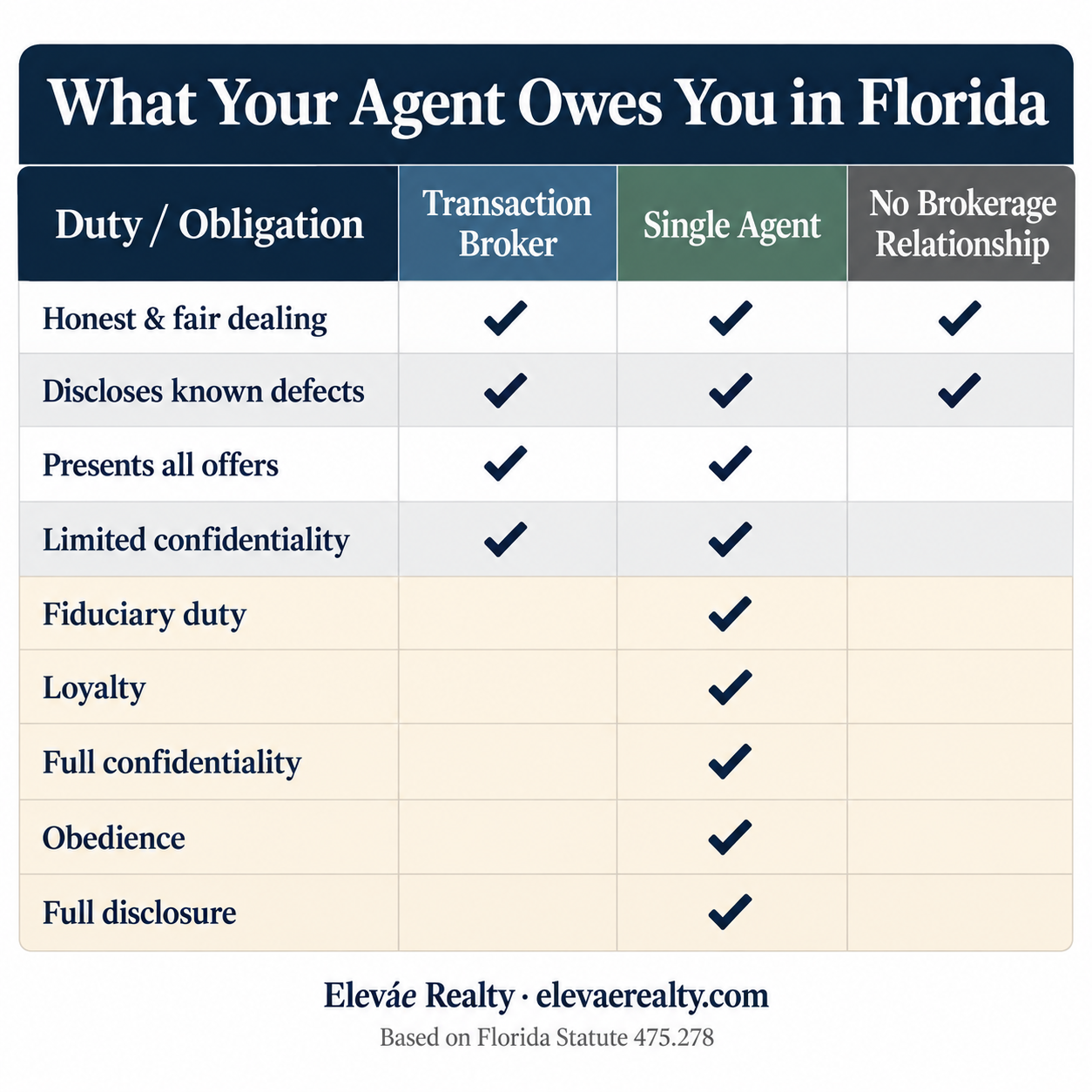
A transaction broker provides limited representation and owes you no fiduciary duty. They must deal honestly and fairly, use skill and care, disclose known facts that affect the property's value, present all offers promptly, and account for any money handled. They also keep certain things confidential — for example, they won't tell a buyer you'd accept less.
What they don't owe you is loyalty, and they aren't your advocate. If they're working with both the buyer and the seller, Florida law says they can't work for one side to the detriment of the other. Their job is to facilitate the transaction, not to fight for your side of it.
In my view, if your agent owes you no fiduciary duty, advice on what to offer is advice without accountability. That's why I believe single agency matters most when real money is on the table.
2. Single agent
A single agent works only for you and owes you fiduciary duties — the highest level of legal responsibility an agent can have. On top of everything a transaction broker owes you, a single agent owes you:
- Loyalty: your interests come first, every time
- Confidentiality: your motivations, your bottom line, and your timing stay private
- Obedience: they follow your lawful instructions
- Full disclosure: everything they learn that could affect your decision, they tell you
In plain terms, a single agent is on your side of the table, in every conversation and every negotiation.
3. No brokerage relationship
This is the least common, and it usually shows up in one situation: you're selling your home yourself (a "For Sale By Owner"), and an agent brings you a buyer. That agent works with the buyer and has no brokerage relationship with you. They must still deal honestly with you, disclose known facts that affect the property's value, and account for any money they handle — but they don't represent you in any way. You'll sign a form acknowledging this, so read it before you go under contract.
What no agent owes you
No agent, even a single agent, replaces a home inspector, an appraiser, a surveyor, or an attorney. An agent must disclose problems they know about, but finding hidden defects is what inspections are for. If you skip one, no agent can make up for it.
Why most brokerages default to transaction broker
Single agency comes with real liability for the broker. Loyalty, confidentiality, obedience, and full disclosure are serious legal duties, and the broker is responsible for every agent meeting them on every deal. Many brokers decide that risk isn't worth it with dozens or hundreds of agents they can't watch day to day, so they offer transaction brokerage only.
There's also the in-house problem. Florida doesn't allow dual agency, so one brokerage can't be a single agent for both the buyer and the seller in the same sale. Big firms run into that constantly.
Here's what makes it confusing: you'll still hear plenty of transaction brokers say "my client" or "my buyer." Those words suggest a loyalty the agent doesn't legally owe you. Many agents honestly don't know the difference. It's not deception, just habit — but it leaves you believing you have an advocate when you actually have a facilitator.
Your listing belongs to the broker, not your agent
Most sellers don't realize that when you sign a listing agreement, you're signing with the brokerage, not with the individual agent. Legally, your listing belongs to the broker.
At large firms with hundreds of agents, that broker may never see your file, never know your name, and never be involved unless something goes wrong. Most sellers couldn't tell you who their broker is at all.
When I list your home, the broker is me. The person who signs the agreement is the same person who prices your home, negotiates your offers, and answers your call.
What single agency means when you're selling
- Your pricing strategy and your reasons for selling stay between you and your agent
- Advice flows one direction: toward what's best for you
- Every negotiation is handled entirely on your behalf
For someone selling a home they've owned for decades — often while also planning the next move — having someone fully on your side can make the whole process feel very different.
When single agency can't apply
If your agent's brokerage also represents the buyer, the relationship has to be transaction broker, and Florida requires your written consent to that change up front. A good agent tells you about this possibility at the start, not in the middle of a deal.
Ask before you sign
In Florida, if nothing is put in writing, your agent is presumed to be a transaction broker. You may never be told that unless you ask. So ask what relationship you'll have, and whether the brokerage offers single agent representation at all. Many don't.
As the broker of my own firm, I make that call myself, and I offer sellers both options. There's no corporate policy deciding it for you. We'll talk through which one fits your situation at the kitchen table, before anything is signed.
Related: Did You Get the Agent You Hired? →
More insights like this, in your inbox.
Ready to talk?
No pressure, no obligation. Just an honest conversation.